|
September 2025 It is planning time again – barely six months have passed since our last winter escapade, a month in Málaga and a month in France. This January we brought our two granddaughters, now young adults, with us for a couple of weeks in Spain and it was a special treat for all. One explored the adventure tours and the other the museums and we all had a lot to share at the end of the day. That was our third winter in Málaga and we are wondering, is there any other equally interesting winter destination?
The planning Our thoughts turn to Italy, a country we have enjoyed visiting on several occasions and which may offer the potential of winter-friendly weather. We have seen Venice, Naples, and the Ligurian coast off cruise ships, as well as motored to Rome, Florence, and through Tuscany, but never in winter. We had previously considered Sicily, Italy’s southernmost point and reputedly mild albeit wet in the winter. Digging deeper, we learn that a lot of services and facilities are closed or operate with uncertainty in winter, and we decide to search further afield. We reject other southern locations – Puglia, Amalfi coast in Italy, for example, and Malta – for the same reasons. One location, however, stands out in our memory. We had passed through the small medieval city of Lucca on a motor trip in Tuscany two decades earlier and stumbled upon a large antique market there spanning many city blocks. It turns out that this antique sale is on every month, and this spurs us to further research. Barry comes across a Facebook group called “We Love Lucca”, an English-language group with many British contributors, and posts a question about January weather. Answers flow in abundantly, and the consensus is that temperatures range between 6o -14o, it never freezes or snows, but it rains a lot and not everyone heats apartments well. That begins to sound manageable to these Canadians. Waterproof footwear, umbrella, layered clothing, and we should be fine. Lucca is an old city and is surrounded by a Renaissance-era wall that was originally built as a defensive rampart, replacing earlier walls as the medieval city grew. Known as a city of 100 churches, there is a towering Romanesque-era church at almost every piazza with narrow, medieval-scale streets meandering off in every direction with many medieval buildings still intact. The city is flat within the walls, therefore easily walkable. A small, more modern city surrounds the walls. It sounds more interesting at every turn. We turn to our usual resources for apartment hunting – vrbo.com and booking.com – as well as seek out local vacation rental agencies. Our criteria are simple: inside the walls, centrally located with restaurants and grocery stores nearby, and with some form of central heating with adjustable control. Many email conversations later, we select an apartment from “Lucca Apartments and Villas”, near Piazza Napoleone and in close proximity to the antique sale and the main shopping and restaurant streets.
How do we get there? There is no airport in Lucca. The nearest one is in Pisa, about a half-hour car ride away, and then there is Florence, about two hours away. Getting to these airports can be tricky for us, as there is no direct flight from Montreal to either, so we are facing two or three flights, changing airlines partway, which means picking up luggage somewhere and checking in to another airline, all while jet-lagged after an overnight trans-Atlantic flight. Researching flights into Pisa, we discover that Ryanair flies to Pisa twice weekly non-stop from Málaga. Hey, we like Málaga! An itinerary begins to come together - Málaga for 10 days, and then Lucca for 2 weeks (which coincides with the antique sale dates), before returning to our usual haunts in France for February. And, since we depart Italy from Florence Airport, we insert a few days in Florence, which we have not seen in 2½ decades. Because we will be there. Two months total. We will need ground transport throughout. There is a train to Lucca that leaves from central Pisa, but we have to get to the Pisa train station from the airport somehow. We will be arriving at the airport early evening, and we have no notion of the delays we may face entering Italy, so we decide to reserve a taxi directly from Pisa airport to be sure to get to our apartment at a reasonable time. The apartment rental agency suggests a half-dozen drivers, and Barry requests estimates. Everyone communicates in English coloured with a certain Italian charm we recall from years ago. We choose Fabrizio, from Albatros drivers in Lucca, who signs his messages as “the coachman of the Gods”. How can we resist? With Málaga and Lucca booked, we reserve a hotel room in Florence for 3 days, a flight to Nice, and then we secure our usual apartments in Nice and Le Lavandou. There is an hourly train from Lucca to Florence, easy taxi connections in all other locations, and a car rental in Nice for our stay in Le Lavandou to complete everything. Air Transat flies directly Montreal to Málaga and returns non-stop from Marseille, where we will drop off the car. The planning is complete. C'est parti! We depart Montreal on New Year’s Day 2026, arriving in Málaga airport early the next morning, where we board the shuttle bus “A” to the historic centre. Málaga is still in the thick of the holiday mode -- the streets are decorated with lights in the form of angels and stars and other Christmas symbols, some as tall as the buildings they stand beside, 2.7 million lights in total. We have never seen the Christmas display before and will have to wait until dark to fully appreciate them. At ground level, “rebajas” (discounts) signs are plastered across storefronts throughout the shopping district although nothing is open at this early hour. The only activity at this hour seems to be workers going to and fro and city crews busy with the endless routine of keeping the city clean. It is early morning, although our bodies still think we are still awake from yesterday and it is two hours past midnight. We would like to deposit our luggage somewhere so that we could walk around a bit until proper check-in time, but our apartment is not ready. We have difficulty communicating with the owner, who is tied up in his day job. We face a delay of 2 hours before we can leave our bags in the apartment. We wait at the little coffee shop next door until the cleaning crew arrives. This is the first time in a long while that we have rented from an individual rather than an agency. Understandably, our agreed check-in is 3:00 PM, however, agencies offer bag drop options. In future we will give preference to agency-managed properties. In the meantime, we have a few hours until three o’clock, when we can properly settle in. We begin our daily routine of walks, checking out some of our favourite locations – the central market, the bakeries, the restaurants and shops -- and discover to our delight that little has changed. Returning to the apartment at three o’clock, we find all is set up for us. Simply furnished, with modern lines and neutral colours, everything branded “IKEA” including the appliances, the beds are comfortable and we quickly settle in for some catch-up shuteye, setting an alarm for 2 hours.
This year, we are earlier than
usual so we can enjoy the tail end of the Christmas festivities but will be
leaving before the preparations of lights for Carnaval. The crowds last all
weekend, and then on Wednesday, the day after Epiphany, the lights are switched
off and the city crews begin Our daily strolls take us though familiar territory – the port, Plaza Merced, Soho, as well as the antique market in Fuengirola, an hour’s bus ride away. We seek out the new exhibits in the museums. We average about 8000 steps a day, something unattainable in a Montreal winter where sidewalks are more often snow and ice-covered than not. Ten days pass but it seems like a blink of an eye. It is time to move on.
Monday, 12 January, 2026 We have heard rumors about quality problems with Ryanair, a bargain-price European airline; however, our 2-hour flight to Pisa is comfortable and efficient. Our luggage arrives quickly and we are out the door in minutes, with no checks needed having flown in from Spain, a Schengen zone country. Our taxi driver is waiting, and we are soon on our way to Lucca. The Tuscan countryside is enveloped in evening darkness, offering little to see as we speed along the highway. Within a few minutes we reach the outskirts of Lucca, with abundant traffic, headlights, taillights, and a cacophony of businesses, including a variety of fast foods from multiple pizzerias to McDonald's. After a few blocks, we pass through an opening in the city wall. Inside, the streets are narrow, paved with stone, the surface slightly uneven and with no sidewalks. There are street lights but in this mostly residential area windows are not large, so the buildings appear generally dark. The stones are wet. There must have been some rain giving the street a slight glisten as the damp stones reflect the street lights and cast the light traffic and pedestrians who share the street in shadow. We arrive at our destination. On one side of the street is the Palazzo Ducale—erstwhile residence of Napoleon Bonaparte’s sister Elisa Baciocchi, who once ruled Lucca. On the other side is our apartment occupying the ground floor of a modest three-storey stucco-covered stone building of indeterminate age. Stella, from the rental agency, is there to greet us and welcome us into the cosy one-bedroom apartment with large kitchen, once again, the entire apartment an IKEA showroom double (simple, clean, comfortable). We get a sense of warmth as we enter the apartment. There is a large wall-mounted hot water radiator in the living room to heat the living and dining areas and the kitchen and another in the bedroom. It is past 8:00PM so we make our way right away to a small grocery store a few blocks from the apartment to purchase some breakfast items. Then we venture out to find a restaurant, heading first to Piazza Napoleone, beside the apartment, then on to Piazza San Michele, a few blocks toward the city centre. Most places are closed on this Monday winter night, and the few that are open are bars, not serving food or kitchens closed. Around the corner from San Michele the Bistrò del Piccolo Mondo is open and we feast on delicious pasta and pizza and Tuscan wine. This is our first taste of the delicious Tuscan veal-stuffed ravioli that we will enjoy a few times again. Back at the apartment, there is a chill in the air. The heat has cycled off and the humidity and uninsulated stone walls and stone floor do little to sustain the comfort level, especially as overnight outdoor temperatures dip into the single digits. The thermostat is set at 20o but the air feels like less and we cannot adjust it – it is done remotely by the owner. (In Montreal, we generally keep our home at 21o in the winter.) According to the instructions provided at the apartment, it is illegal to heat above 19o in Italy as an energy conservation measure. We talk to the representative of the rental agency later that week and are able to have the temperature raised a degree, which makes a big difference. Nevertheless, heavy sweaters and warm socks are de rigueur indoors in these old stone buildings. The next morning, we begin our exploration of Lucca. We head towards the Piazza dell'Anfiteatro, an oval plaza on the site of the ancient Roman amphitheatre, today surrounded by medieval buildings. It is a 15-minute walk along Via Fillungo, the major commercial strip through the centre of the walled city. Far from thoroughfare, Via Fillungo is barely wide enough to accommodate two vehicles wide and is shared with pedestrians as there are no sidewalks. This does not seem to bother the locals, who easily dodge the service vehicles and buses that pass. A parade of high-end Italian designer boutiques mixed with other European retailers line the route. At our destination, an arched passageway leads us into the ancient amphitheatre oval. In-season, this would be ringed by restaurant terrasses and buskers; today, mid-winter, a couple of establishments have tables set up with gas heaters and umbrellas. We stop indoors at the Pizzicheria La Grotta, at the northwest corner of the piazza, and enjoy a delicious lunch of bruschetta and Tuscan soups, a perfect complement to the mid-day chill.
A Walking City The historic section of Lucca
within the walls spans an oval roughly one by two kilometers, its streets
largely arranged in a rectilinear fashion as originally laid out by the Romans.
Despite the occasional unevenness of the stone pavement, Lucca is flat and
easily walkable. Compact and contained within its walls, Lucca gives us the
opportunity to wander freely and explore its many corners without any worry of
getting lost. Mid-winter, the only preparation is Every few blocks, where streets cross, the space opens up into piazzas, offering surprises at each turn. One of the larger piazzas, Piazza San Michele, around the corner from our apartment, is on the site of the ancient Roman Forum, at the intersection of the main north-south and east-west roads of Roman times. The Piazza is named for the Church of San Michele in Foro (St Michael in the Forum), whose origins on the site date to before the 8th century. The current building, from the 13th century, is an elaborate example of the Romanesque churches that typically stand alongside the many piazzas scattered throughout Lucca – a massive base topped with one or more loggia with columns and round arches, and built up wedding-cake style to the sky. The churches are usually open to worshippers and visitors, allowing us to appreciate the wealth of medieval and Renaissance paintings and sculptures within.
The wall The Renaissance-era fortification, built of stone and earth, is fully intact, among the best preserved in Europe, 12 meters high and 30 meters wide at the base. Today the top of the defensive wall is a pedestrian promenade and park, stretching 4.2 km, with 11 bulwarks and six gates passing underneath. The promenade is also popular with cyclists, and bike rental shops abound in town. There is an ice skating rink and snack bars above the Porta San Pietro and an interpretation centre at the Porta San Donato. We enjoy the walk along the wall, where you can appreciate the interplay of the textured rooftops and bell towers of the city nestled within the protective wall on one side and the Tuscan mountains looming in the distance on the other.
Market day On Wednesday we head outside the city wall through the Sortita San Frediano on a path that takes us across massive lawns, once smaller fortifications, and then past a residential area to the Piazzale Don Baroni. This space is transformed into a bustling marketplace as about 70 vendors have set up stalls selling all sorts of merchandise from modern Italian design clothing and leather goods that rival downtown for affordability to linens and housewares and some food items as well, all in a convivial atmosphere.
The antique fair It is morning of the third Saturday of the month, time for one of Italy’s oldest and largest outdoor antique fairs, a two-day event. We peek through the window of our apartment entry door which gives us a view across the north side of the Piazza Napoleone, a block away. There are a couple of tents set up at the far corner of the piazza. The sky is clouded over. Some people are out walking, a few carrying umbrellas, a winter essential, but the forecast is for mixed sun and cloud. We head out after breakfast, crossing the piazza to what is informally known as the “Via degli antiquari” (antique dealers’ street), the Via del Battistero, where many antique shops are located. This is the centre of the outdoor event, which is slowly filling up to fill five piazzas and over a dozen interconnecting streets, spreading across an area extending more than a half-kilometre square. There are over 200 vendors setting up tables laden with objects that will take us on a trip through Italian and European history from vintage 1970’s back to some indeterminate historical time – ceramics, wooden, copper, straw, small furniture, paintings, prints, books, and all sorts of crystal, silver, and other trinkets that catch our eye. We are interested in the widespread availability of memorabilia related to Italy’s Fascist history – membership cards, school children propaganda – and pick up a variety of these and other items that we know will interest our collector friends back home. The sky clears and we manage to visit the entire sale, with a stop for lunch at Il Cuore on Via del Battistero for a delicious Tuscan pasta and focaccia. As always, the owner is happy to greet Canadians and especially Montrealers, where many Italians have family or friends and stories to share. We return to the sale the next day for a second pass under the warming Italian sun. It is always slightly different the second day as some of the vendors had not fully set up yesterday or there are objects we would like to have another look at. Or, perhaps, it is just a good excuse to get out.
Pisa A mere 20 km apart, Lucca and Pisa were rival independent city-states for much of their history. Pisa was once a powerful seaport; however, build-up of silt from the Arno River effectively transformed it into an inland city by the 15th century. Pisa was taken under control of Florence in 1509, while Lucca remained a republic until 1799 when it was overtaken by the French and ultimately became a monarchy under Napoleon before becoming part of the Grand Duchy of Tuscany and then, finally. the Italian State. Pisa is singularly famous today for its 12th century leaning campanile, alongside its impressive cathedral and baptistery (and surrounding souvenir shops selling fridge magnets and miniature leaning tower figures). We had visited the cathedral and tower on a previous motor trip and are now curious about the medieval centre of modern Pisa, having spent some time in rival Lucca. A thirty minute train ride brings us into Pisa. We leave the train station and head toward the Corso Italia, a narrow avenue that feels broad because it is a car-free, lined with shops and restaurants and with many people strolling in the winter sunshine, and proceed toward the Ponte di Mezzo, the bridge that crosses the Arno River. We pause on the bridge, and admire the view of the Arno River, mirror-like in the still of the day, as it curves lazily through the city, dividing Pisa into two, with Renaissance and medieval palazzos lining the avenues on both sides. We cannot imagine this as a bustling seaport. We cross into the city centre, and continue along the narrower Borgo Stretto, with its arcades, cafés and small piazzas in the shadow of the medieval architecture. To the left, the Via Ulisse Dini takes us to the Piazza dei Cavalieri, once the political centre of Pisa, the meeting place of the people. It is a large open space, now lined with large medieval and Renaissance educational, religious and official buildings and several monuments as well. We are at the edge of the university district and take a narrow street off the piazza into the student area. We stop for lunch at Café Cavalieri (Via Corsica 14), where we enjoy the salmon bowl, a delicious and healthy alternative (quinoa, edamame, avocado …) to the pasta and pizza offerings that tend to dominate Italian menus. We are only a few hundred metres from the Cathedral and leaning tower which are adjacent to the northern section of the medieval wall that once surrounded Pisa. However, we have not gotten a sense of walled city. Indeed, the southern section of wall at the Arno River has long been demolished as the medieval city expanded beyond its original boundaries. What is left today is a city bustling with modernity in a setting of antiquity. The contrasts are a continual treat for the eyes. We head back to the large oval Piazza Vittorio Emanuele II across the river and enjoy a coffee in one of the many terrasses as we admire the social space, often used for fairs and events, its large oval surrounded by modern curved hotels and apartments and offices. The train station is just a couple of blocks away, and we are soon back inside the walls of medieval Lucca. Sort of like a cocoon.
Food We love Italian food. There is no shortage of pastas and pizzas on restaurant menus in Lucca. And hardly a bad one in the mix. Restaurant protocol in Italy is different from our accustomed habits in France and Spain. Menus list antipasti, primi piatti, secondi piatti, contorni and dolci (appetizers, first courses, second courses, sides and desserts). In the past, we were usually expected to order one of each course per person; however, restaurants seem to have no issues today if we order only one item or order plates to share. In fact, shared orders are often served on separate plates. Waiters do not usually bring a bill. You go to the cash, pay your bill, and then enjoy a glass of limoncello or some other liqueur, occasionally with a chat with the owner. Most restaurants offer local (Luccan or Tuscan) dishes or use local names for dishes we might know as something else. Typical Luccan fare includes tordelli, a ravioli stuffed with delicious herbed-meat filling, and ribollita, a bean and vegetable and bread soup, often referred to as “peasant” fare, delicious nonetheless on a cold winter afternoon. Tripe is commonly seen on menus, however, that is an avenue we do not take. We discover the aperitivo con tagliere, literally “aperitive with cutting board”, a late afternoon ritual in bars where ordering an aperitif comes with a wooden board with small appetizers – focaccias, cheese, and other bite-sized treats. This is occasionally enough for our evening meal. Two restaurants merit return visits. The Trattoria da Léo at lunch serves a varied menu with all the usual Tuscan offerings as well as items such as roast veal with roasted potatoes, spare ribs, and fried chicken. It is a pleasing alternative to the pasta-rich menus everywhere else. We discover the Torta di fichi e noci, fig and walnut pie, as a new favourite dessert. Léo’s is popular with local workers at lunch and Denise remarks at one point that she is the only woman in the restaurant. Two visits and the owner recognizes us as regulars as we enjoy an after-lunch liqueur at the counter. (Trattoria da Léo, Via Tegrimi, 1). We also enjoy several lunches at Rusticanella 2 da Luca, Via San Paolino, 32, which advertises itself as Il Trippaio di Lucca (The Tripe Seller of Lucca) but offers a wide range of other Luccan standards and daily homemade ragús and other specials in a warm and friendly atmosphere. Our apartment is fully equipped so we can eat in, too. However, cooking is not a large part of our plan, so in-house is limited to breakfast (cereal or whole-grain toast, eggs) and the occasional pasta with tuna, or salad, or take-out pizza. The grocery stores and bakeries offer little bread variety apart from focaccias and some fancy grain breads. We enjoy prepared vegetable soup in the grocery refrigerator counter and pastries from the bakery. Baguettes and croissants will just have to wait. Guggenmusik
The big event, a parade, starts at 2PM in the afternoon. It is called “Guggenmusik”, referring to the Carnival marching band and the type of music it plays. The bands come primarily from Switzerland, Austria and southern Germany, and the parade is to kick off carnival season in Europe. The masks and costumes, along with a lot of percussion, are meant to chase off the spirits of winter. This is the first time Guggenmusik will have been staged in Tuscany.
The crowd follows the last band to the city centre, where there will surely be a lot more music and beer. We are content to return home.
Arrivederci Two weeks have passed. We had expected to see a lot of expatriates and tourists on our walks and in the restaurants, but such encounters have been few. Lucca is a warm weather destination and relatively quiet during the winter. Many restaurants and other businesses have limited or no winter hours. We mingled with locals, mostly restauranteurs or antique dealers, and with a combination of our halting Italian, sometimes conflated with Spanish, and French and English, and many Italians’ English or French, we were never lost or misunderstood. The Italians we met are spirited and friendly, and we can imagine returning to Lucca without hesitation. Our bags are packed and we call a taxi to the train station, normally a 20-minute walk from our apartment but challenging when wheeling large suitcases on the bumpy pavements, well worth the price. It is a quick ride, our train is on time, and before long, we are en-route to Florence.
Florence The Florence train station is abuzz with people arriving mid-day, and we are swept up in the crowd as we move toward the exit. Our hotel is just a ten-minute walk from the station, but the confusion of roads, traffic, and the uneven paving stones make a taxi ride desirable and worth every centessimo. We are staying at the Hotel Perseo, a 20-room family-run boutique hotel situated on the upper floors of a building with elevator, a few steps from Florence’s famous Cathedral, an ideal pied-à-terre for visiting the historic centre. The room is modern and cosy, the staff very friendly, and the hotel offers an excellent breakfast variety. (Hotel Perseo, Via de' Cerretani, 1) We were in Florence nearly three
decades ago, and, unsurprisingly, the historical centre is largely unchanged.
What has changed is tourist behaviour, particularly the tendency of visitors to
focus on their smartphones instead of To the east of the Duomo, on the streets that surround the central food market and that lead to the Church of San Lorenzo, the leather market is alive with dozens of outdoor vendors selling wallets, handbags, belts and other products made from the durable vegetable-tanned leather of the Florentine region. To the south are some of the oldest buildings in Florence, leading to the Ponte Vecchio over the Arno River, where jewelers have been plying their trade for centuries. We stop at the Bargello Palace chapel and Museum, appreciating some of the greatest art and sculpture of the Renaissance era. A twenty-minute walk to the west is the Santa Croce district, home to the Mercato di Sant’Ambrogio, a neighbourhood food market with restaurant tables as well and the Mercato delle Pulci, an inner-city antique market that gives us an opportunity to browse some affordable treasures and enjoy some Tuscan food in a casual setting. Having spent two weeks in Lucca, we are no strangers to Tuscan cuisine, but Florence, the capital city of Tuscany, brings a unique twist to this. In particular, many restaurants in Florence display massive slabs of raw beef in refrigerated window displays as you enter. This is the beef loin served as “Steak Florentine”, a thick cut porterhouse steak. One night, as we are in a restaurant savoring our paper-thin morsels of beef carpaccio, we overhear a gentleman sitting alone at the next table ordering the steak. The waiter asks “one kilo?” and he replies “yes”. (One kilo, or 2,2 pounds, is the minimum order size of a steak Florentine.) The steak arrives, an oversized hunk of beef sizzling on a board, several centimetres thick, accompanied only by a serving of potatoes. Shouldn’t something called “Florentine” should be more delicate than that? After all, Florence was home to Michelangelo, Leonardo, Botticelli, Donatello, and so many others. It is time to move on to the land of steak-frites, croissants, and baguettes.
Friday, 30 January Nice-Côte d’Azur airport is situated on a promontory jutting into the Baie des Anges, a bay of the Mediterranean where the city of Nice is situated, barely 100 kilometres from the snow-capped Alps. It has been our arrival or departure port many times over the last three decades, and welcomes us home once again. Our apartment is just a few steps from Vieux Nice, where the labyrinthine medieval streets are home to a wide range of shops and restaurants and other discoveries, and then open up on the Cours Saleya, the large open space where a daily flower and food market gives way to a large antique market on Mondays. Between the antique market, the Puces de Nice near the port, and the regular vintage and book fairs at the Palais de Justice, we find many opportunities to browse the treasures of the past and to re-connect with some of the vendors we have met on previous trips. Nice’s central neighbourhoods are neat and architecturally interesting, pleasant for walking. The varied restaurants and bakeries and grocery stores offer much choice; on our first day out, we opt for standard brasserie fare – a long-awaited steak-frites.
Friday, February 5
Efforts are underway to prepare for the Fête du Citron, a
150-year-old event that will begin in mid-February to celebrate Menton’s
production of specialty lemons and other citrus fruit. We pass large floats
being constructed, covered with many hundreds of lemons and oranges, in
preparation for a grand parade, a nineteenth-century tradition designed to
attract the nobility who would come to Menton for its mild winters. Side-shows
and carnival rides for families of all ages are being The shuttle drops us off near the ancient entrance to Menton harbour. The Mediterranean waterfront is being battered with waves higher than we have ever seen, but the street is dry. We sidestep the Fête construction to reach the central marketplace. Only a few antique vendors have set up today because of the strong winds. We walk back to the commercial centre of the city, admiring the colourful former palaces, now hotels or apartment buildings, and the shops and cafés that line the main avenues, seeking out the side street antique shops. We continue to Boulangerie Jean-Luc Pelé where an assortment of savoury foccacias makes a pleasing lunch. The shuttle bus stops outside the bakery, saving us from having to do the steep climb to the train station, and an easy ride back to Nice.
In Vieux Nice We regularly walk in front of the Opéra de Nice, a magnificent Belle Époque structure facing the Mediterranean on one side and the entrance to the Cours Saleya on the other. A sidewalk sign advertises “Mozart’s last opera”. We are intrigued as neither of us has ever attended a performance of an opera. Will there be a better opportunity? This opera is called “La Clemenza di Tito”; we never heard of it, but with Mozart’s byline, the show is bound to be special. We check at the box office, and some good seats are still available. We obtain tickets for a performance later this week. There has been a theatre on this site for centuries; audiences have included Napoleon III and the Tsar of Russia. The current building dates from the 1880s, replacing one that was destroyed by fire. We enter a lobby of majestic scale. A ceremonial horseshoe-shaped staircase, surrounded by marble columns and crystal stained-glass windows, leads up to the parterre lobby, where we enjoy a glass of champagne before entering the theatre. Inside the performance hall, a monumental crystal chandelier illuminates a large ceiling fresco of a vast mythological sky, and cream-coloured loges are adorned with classic décor of gold and lined with red. The circle around the balconies is decorated with paintings of creatures of mythology, including Apollo, god of arts and music, and Aphrodite, goddess of love. The curtain rises and a woman walks onstage in a red business suit carrying a briefcase. The only sound is the clicking of her heels. She sits at her desk and opens her laptop, presumably checking her email. The setting is modern (more IKEA?). Is this a live ad for something? Then the music starts. It is Mozart. She sings. The words are Italian (surtitles displayed in English and French). Something about revenge because she, Vitellia, expected Emperor Titus Vespasian to take her as his wife but he appears to be giving his troth to another. If the vision is modern, the story is timeless. (In a departure from habit, Denise, who sometimes cannot help herself from singing along with anything from pop songs to cathedral carillons, does not sing.) La Clemenza di Tito (The clemency of Titus), is all that we think Italian opera is about: love, power, jealousy, political intrigue, conspiracy, betrayal, and forgiveness. All in two acts. Mozart’s masterful blend of music and voice is beautiful and often glorious, taking us on a musical ride that will last a long time after the last notes have faded.
Wednesday 11 February With so much to choose from, ten days in Nice seem to pass quickly. One more destination awaits. We pick up a car and head out to Le Lavandou, the small city by the beach surrounded by the Massif des Maures mountains at the western side of the Côte d’Azur. We will drive around and across these mountains many times as we take day trips to visit nearby markets and towns. We stop in Bormes-les-Mimosas, just outside of town, and enjoy lunch at some friends, Marie-Noelle and Paul, whom we first met in 2018, and then every year since (except during the pandemic lockdown). We will see them regularly during our three-week stay, our annual get-together. We check into our apartment and head out for a walk along the beachfront of Le Lavandou, again noting that little has changed from last year. As always in February, some places have been closed but are starting to re-open as winter school break has begun and there are many tourist families from across France in town. The outdoor terrasses and the boules courts are busy under the February sun. We pass Sur la Côte, one of our favourite restaurants, and the owner is outside placing his sandwich board for the day, He recognizes us, heartily welcoming us back. We go in to reserve a table for Valentine’s Day. Denise wants to give her name and number, but he says he has already reserved the table under the name “habitué”. For the first days, we stay close to home as a mistral, a heavy wind, blows through the Côte d’Azur, bringing the tops of the tall palms lining the street in front of our apartment to bend to the horizontal. Nevertheless, we consider ourselves lucky as we watch with sadness reports of Atlantic storms battering the western portion of the country and tens of thousands of people losing their homes to rising waters from non-stop rain ranging from the Bordeaux region to the Loire valley. It has rained for 35 days, breaking all records. It makes complaints of the exceptional cold in Canada seem petty. The winds are so strong that the weekly outdoor food and clothing market is cancelled for the first time in its history. After two days of gusts and almost non-stop blowing, the wind abates and regular life resumes, walks along the beachfront and drives to the markets in nearby cities – seaside Hyères to the west and St-Maxime and St-Raphaël to the east, Cogolin on the Gulf of St-Tropez, Barjols perched stunningly in the heights of the Massif des Maures. We are earlier than usual, and in
March, Le Lavandou is staging their “Corso Fleuri”, an annual celebration of
spring, also known as the festival of the sun The parade ends and there is a “battle of the flowers” event scheduled – we do not attend this and spend time with our visitors instead. The crowd of onlookers begins to disperse, another parade passes our apartment, women, men, children, each carrying a bouquet of flowers as they return to their homes or cars. The party is over but there is still a sense of celebration in the air. For us, too. Tomorrow we pack our suitcases in preparation for our return to Canada. There is snow and it is cold when we get home. Spring is just around the corner. |
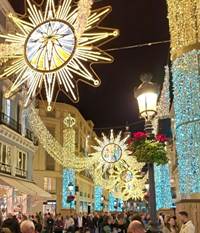 It
is early Friday evening when we step outside again, somewhat refreshed. The
flow of people toting small travel bags - weekend tourists - into Málaga’s
historic centre seems particularly heavy. It is as if the entire Costa del Sol
is emptying into the city. Nightfall settles in and the city decorations are
all illuminated. The streets are full of people walking, going to no particular
place, admiring the lights, children, seniors, and everyone in between. We
manage to secure an outdoor table at the Taberna del Pintxo where we can
appreciate the lights, watch the crowds, and enjoy their Basque-style tapas and
Spanish wine. We have not seen such crowds since Carnaval, with its own
displays of lights and musical events.
It
is early Friday evening when we step outside again, somewhat refreshed. The
flow of people toting small travel bags - weekend tourists - into Málaga’s
historic centre seems particularly heavy. It is as if the entire Costa del Sol
is emptying into the city. Nightfall settles in and the city decorations are
all illuminated. The streets are full of people walking, going to no particular
place, admiring the lights, children, seniors, and everyone in between. We
manage to secure an outdoor table at the Taberna del Pintxo where we can
appreciate the lights, watch the crowds, and enjoy their Basque-style tapas and
Spanish wine. We have not seen such crowds since Carnaval, with its own
displays of lights and musical events. 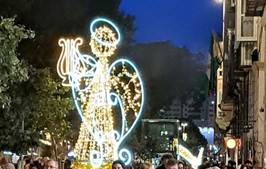 the
long task of dismantling everything before starting all over again for
Carnaval.
the
long task of dismantling everything before starting all over again for
Carnaval.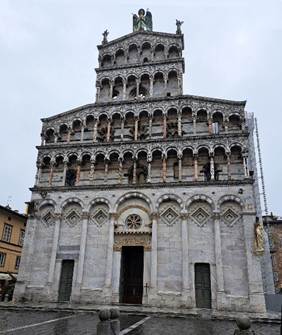 an
umbrella, a scarf, and waterproof footwear as it rains frequently and the
daytime temperature averages around 12o.
an
umbrella, a scarf, and waterproof footwear as it rains frequently and the
daytime temperature averages around 12o.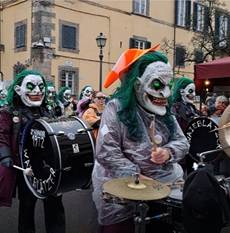 The
“We love Lucca” Facebook page and Lucca tourism web site advertise a music
event scheduled for our last Saturday in Lucca. On our morning walk, we see
groups of musicians and others throughout the centre, dressed in costumes, some
with scary masks, marching around, sitting in cafés, or just set up in piazzas,
with little clips of music in the air everywhere. The music varies from German
drinking songs to North American pop favourites.
The
“We love Lucca” Facebook page and Lucca tourism web site advertise a music
event scheduled for our last Saturday in Lucca. On our morning walk, we see
groups of musicians and others throughout the centre, dressed in costumes, some
with scary masks, marching around, sitting in cafés, or just set up in piazzas,
with little clips of music in the air everywhere. The music varies from German
drinking songs to North American pop favourites.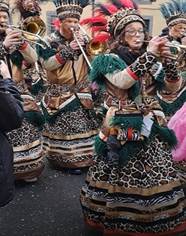 The
35 bands assemble at the Porta San Pietro and march north through the city
centre, through Piazza Napioleone and Piazza San Michele towards the Piazza
dell'Anfiteatro. A light rain does not daunt the musicians nor the crowd of
onlookers that line the route. There is a lot of drumming and other rhythmic
beating as musicians bang on every type of percussion instrument in support of
a full complement of marching band brass (and bottles of beer in pockets and
satchels).
The
35 bands assemble at the Porta San Pietro and march north through the city
centre, through Piazza Napioleone and Piazza San Michele towards the Piazza
dell'Anfiteatro. A light rain does not daunt the musicians nor the crowd of
onlookers that line the route. There is a lot of drumming and other rhythmic
beating as musicians bang on every type of percussion instrument in support of
a full complement of marching band brass (and bottles of beer in pockets and
satchels).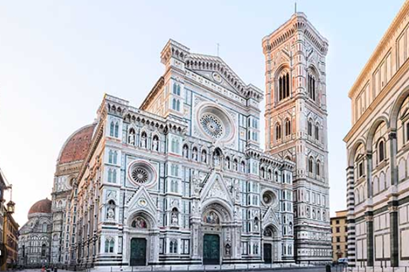 admiring
the sights or just looking where they are walking. (They are referred-to as
“smombies”, or smartphone zom-bies.) The overwhelming presence of tourists in
Florence, particularly tour groups of young Americans, is usually not
surprising, but that it is this busy in late January is unexpected.
Despite the cacophony and the need to watch out for distracted tourists, we get
a moment to appreciate the façade of the Cathedral, as awesome as ever, and the
soaring dome that reminds us of the importance of this monument, the birthplace
of the Renaissance in Europe.
admiring
the sights or just looking where they are walking. (They are referred-to as
“smombies”, or smartphone zom-bies.) The overwhelming presence of tourists in
Florence, particularly tour groups of young Americans, is usually not
surprising, but that it is this busy in late January is unexpected.
Despite the cacophony and the need to watch out for distracted tourists, we get
a moment to appreciate the façade of the Cathedral, as awesome as ever, and the
soaring dome that reminds us of the importance of this monument, the birthplace
of the Renaissance in Europe. 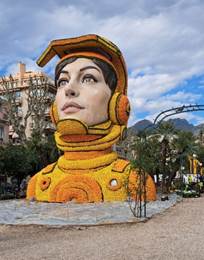 A
short train ride takes us past Monaco (under, actually, by tunnel) to Menton,
the French Riviera city that borders Italy. Menton hosts a small brocante
on Fridays, alongside the waterfront in the centre of of the old city. The
train station is high above the city centre - a free shuttle bus takes us from
the train station to the waterfront. Most of Menton is built on hillsides, with
buildings a medley of overlapping tropical pastels - cream, yellow, gold,
ochre, pink, coral and sea green - that colour the view as we descend to
the coast.
A
short train ride takes us past Monaco (under, actually, by tunnel) to Menton,
the French Riviera city that borders Italy. Menton hosts a small brocante
on Fridays, alongside the waterfront in the centre of of the old city. The
train station is high above the city centre - a free shuttle bus takes us from
the train station to the waterfront. Most of Menton is built on hillsides, with
buildings a medley of overlapping tropical pastels - cream, yellow, gold,
ochre, pink, coral and sea green - that colour the view as we descend to
the coast. 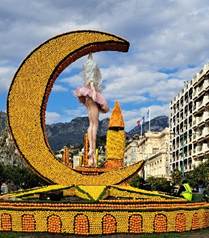 erected
on the waterfront promenade, all of this for a Riviera celebration second only
to the Carnaval de Nice.
erected
on the waterfront promenade, all of this for a Riviera celebration second only
to the Carnaval de Nice. 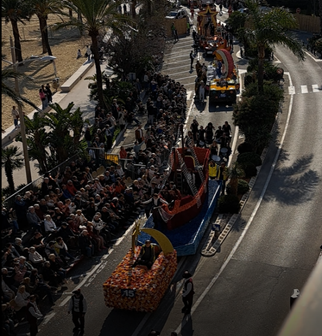 and
flowers. Community members have created 20 floats and decorated them with 100,
000 flowers. The parade includes majorettes, brass bands, and other local
musicians. Impressive for a town of 6000 residents. Our fourth-floor apartment
may not be front-row, but it gives us a privileged vantage point, nonetheless.
Marie-Noelle and Paul have joined us for lunch and to view the parade.
and
flowers. Community members have created 20 floats and decorated them with 100,
000 flowers. The parade includes majorettes, brass bands, and other local
musicians. Impressive for a town of 6000 residents. Our fourth-floor apartment
may not be front-row, but it gives us a privileged vantage point, nonetheless.
Marie-Noelle and Paul have joined us for lunch and to view the parade.